Skip to content
⋅ A FIRST PANDEMIC HIKE ⋅ On a clear day last November, two of us from Sierra Club ICO http://angelesico.org stand with a group of 25 youth at Topanga State Park’s Trippet Ranch. We stand here in the heart of the Santa Monica Mountains, feeling the weight of Topanga’s history. We
⋅ OIL WELLS OF LA ⋅ For many years I didn't know that I lived near so many oil wells in my dense Los Angeles neighborhood. That office building about ¼ mile from me?  It’s a façade for a recently closed oil and gas extraction site.       The
⋅ A PERFECT MARRIAGE ⋅ Do you know what it is like to be out in nature when you are missing one of your senses? At the Sierra Club’s Inspiring Connections Outdoors, angelesico.org we are finding out. We recently partnered with an agency called Hearts For Sight that encourages blind and
⋅ A SEASON OF WOES - FIRE AND ICE IN LA ⋅ Los Angeles January 2025: A terrible windstorm fanned the flames of 2 fires as they raged out of control for days. Most of the neighborhoods in Pacific Palisades, Malibu and Altadena  burnt down. The evacuation system worked well, but
AN EVERCHANGING EARTH:  What would the bottom of the sea sound like without the inventions of modern man? That would be the sound of Los Angeles millions of years ago in the Miocene era. Moving and colliding tectonic plates, earthquakes and crashing waves would replace the sounds of construction and

⋅ A FIRST PANDEMIC HIKE ⋅

Photo Credit: Donovan Pair

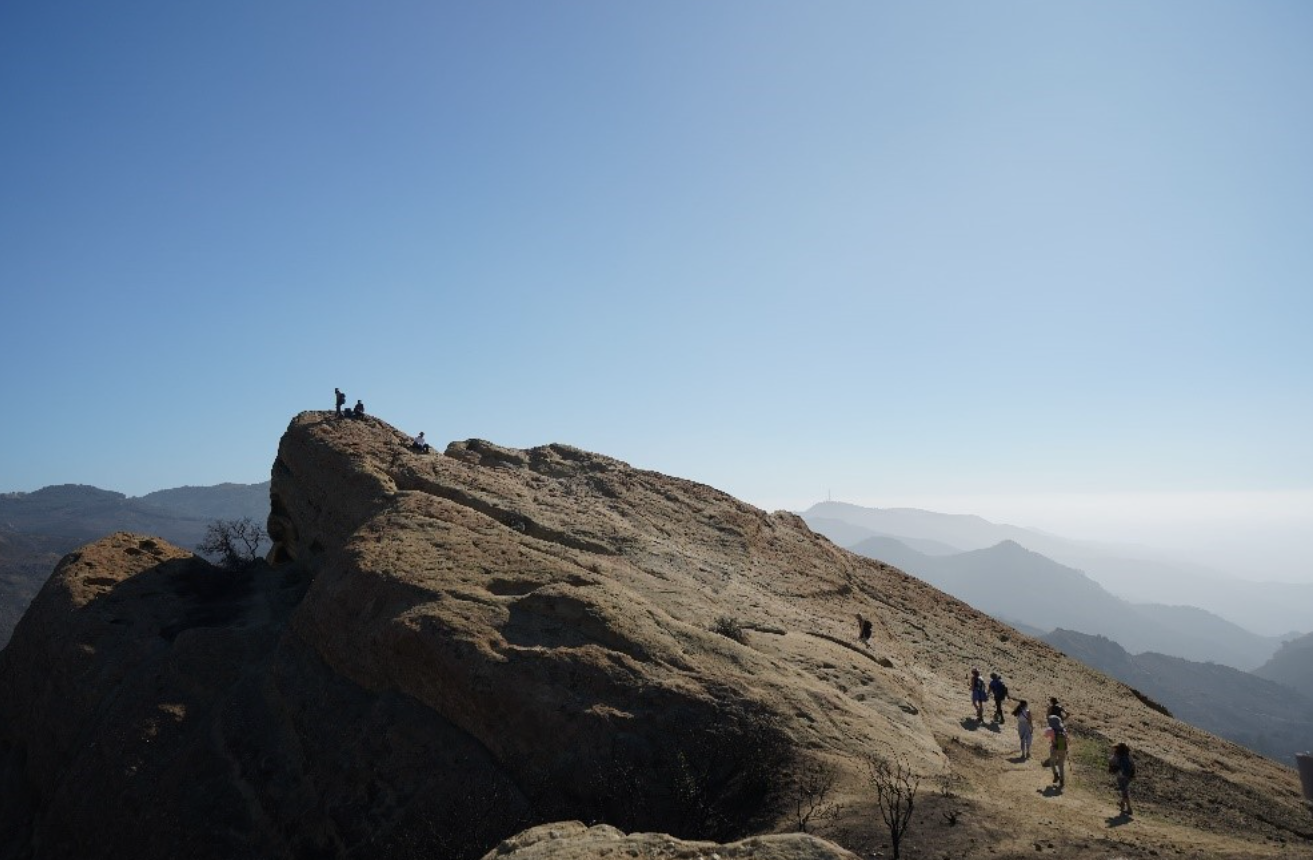
On a clear day last November, two of us from Sierra Club ICO http://angelesico.org stand with a group of 25 youth at Topanga State Park’s Trippet Ranch. We stand here in the heart of the Santa Monica Mountains, feeling the weight of Topanga’s history. We remember the people who made their lives here for so long before the Spanish came in the 1500s – the Gabrielino/Tongva to the East and the Ventureno/Chumash to the West.

Photo Credit: Donovan Pair

Today, the group from Nava Science Academy in South Los Angeles is on its first nature outing since the pandemic began. Their bus ride was long, a ride from one world to another. They are excited to be here, and we welcome them to this beautiful, historical land imbued with the spirit of the Indigenous people. A people who said that their ancestors were brought here by God.

We look around at the plants that provide nourishment and sustenance. The California Bay Laurel with its edible nuts, the Live Oak with its acorns, the fragrant sage and the buckwheat.

Photo Credit: Donovan Pair

We start our hike on the Musch Trail, grateful to be here with our masks, our water bottles and our snacks. The students are talking to each other, pointing out lizards and birds. They exclaim at the signs that warn of rattlesnakes and mountain lions and we tell them that these animals live here, it is their home that we are visiting. These creatures are good hosts and merely watch us from afar.

Photo Credit: Donovan Pair

The students get tired and say it is too hard to walk up so far. How much farther is it? They have been home for more than a year with little exercise. We point out Eagle Rock to them and say it’s much closer than it looks, not too far now. When we turn the corner, we come upon a devastated landscape. The recent fire has left the upper ridges charred and black. We explain that many plants will come back, that here, fire is natural, but is happening too often these days.

Photo Credit: Donovan Pair

At last, we get to Eagle Rock. Victory!! All fatigue is forgotten. Students sit down to eat their lunches. Many scramble with increasing confidence on the rocks, entering the cave at the top. Soon it is time to leave. Everyone is relaxed on the way down, chatting and giggling. They agree that it is a day to remember—this first pandemic hike.

Photo Credit: Donovan Pair

Article by Firoza Jhabvala originally published in Parks California
parkscalifornia.org/2022/04/27/a-first-pandemic-hike

⋅ OIL WELLS OF LA ⋅

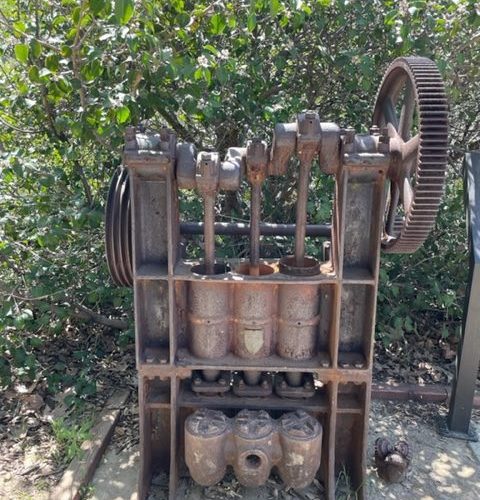
Early Oil Pump At Placerita Canyon

For many years I didn't know that I lived near so many oil wells in my dense Los Angeles neighborhood. That office building about ¼ mile from me?  It’s a façade for a recently closed oil and gas extraction site.

Packard Oil Site Residential Street


Cardiff Tower Oil Site Residential Street


The building that looks like a synagogue? No one goes there to pray. It’s a front for another inactive oil well.


A wall next to the Beverly Center Mall and across from Cedar Sinai Hospital hides a big, active oil drilling site. 


In the historic Adams area of LA, the Murphy oil site operates behind a wall next to a clinic for deaf children, a convalescent home and residential buildings.

The chimney-like flower-power painted structure that used to be at Beverly Hills High School hid a system of oil wells. Once abandoned, the wells were left to be plugged by the City. 


Early oil digging tools

In 1892, when Charles Canfield and Edward Doheny dug the first oil well in Echo Park, LA was a small town sitting on a big lake of oil. At that time it was possible to keep some distance between the oil producing zones  and residential areas. Now, about half a million Angelenos, from Wilmington to Echo Park, to Downtown LA, to the Westside, spend their daily lives less than a ¼ mile from an unplugged oil well. Not all these oil wells are well maintained, operating with broken cement seals and poorly maintained pipelines. Many are abandoned and left unplugged.


Oil derrick in the Inglewood Oilfields

Why does this matter? Because people living near oil wells complain about serious health problems. They are backed up by a scientific panel that reported to the California Geologic Energy Management Division (CalGEM) in 2021, a 2019  National Institute of Health (NIH) study, The Center For Biological Diversity (2017) and a steady drumbeat of studies from universities such as Yale, Stanford and USC.  

Oil derrick at Kenneth Hahn State Park

These studies document the long-term health consequences of living near oil drilling sites. Besides the noise, oozing sludge and odor, chemical gasses such as benzene, hydrosulphide and methane are leaked into the air, causing  wheezing, asthma and generally reduced lung function. People suffer from frequent headaches, nausea, nosebleeds and rashes. High risk births as well as various cancers have also been connected to living and working near oil wells.


Which brings me to the very sensible California Senate Bill 1137 which was signed into law in September 2022, following similar ordinances passed by local governments. If you care for your health and the health of the community, you would support SB 1137. It does not stop oil drilling in California but it does mandate Health Protection Zones (HPZs), 3200 foot buffer zones, where no new oil wells can be dug too close to your homes, schools, hospitals and shopping areas. The wells that are already there can remain within the 3200 foot buffer zone, but the operators have to make sure that the oil wells are working safely and that they, not the taxpayer, will be responsible for plugging the wells when abandoned.

Gas prices in LA 2022

                                                                                          Will SB 1137 affect gas prices? No, it will not!  California crude oil prices are tied to global oil prices and events. Because California only produces 29% of its oil, with its wells getting old and producing less, we are dependent on oil from other states and countries. Since this crude oil has to go through refineries first, the price of gasoline depends on the refineries as well. Gasoline costs more to refine in California than in other states. Fewer refineries, aging infrastructure, refinery outages and higher demand last year caused a supply problem which forced us to pay way more at the pump.

Unfortunately,  SB 1137 was put on hold  by a well-funded campaign called Stop The Energy Shutdown. By December 2022, they had collected enough signatures to put a referendum on the 2024 ballot to void this law. Stop The Energy Shutdown is funded by the California Independent Petroleum Association (CIPA), its top donors being major oil extraction companies. They have peddled lies about stoppage of oil drilling, tried to connect SB 1137 to higher gas prices, said we will lose jobs and disputed the health findings of various reputable studies. In short, they have used their considerable funds to pull the wool over the public’s eyes by using scare tactics to get needed signatures to put the initiative on the ballot. The referendum will be on the November 2024 ballot.

As I walk past that fake office building near my home, I realize that California cannot do without oil and gas right away, not until we can develop other sources of cleaner and more affordable energy. But common sense health and safety measures and the availability of affordable oil are not incompatible. 

UPDATE: JULY 2024  Faced with a strong opposition and new laws making their way through the State Assembly, Stop The Energy Shutdown pulled the referendum from the November Ballot.  Besides undermining the legislative process, spending over $25 million on the referendum wasn't a complete loss for oil drillers as they continued drilling with impunity for another year. The oil companies say they will now take their battle to court, so stay tuned!


⋅ A PERFECT MARRIAGE ⋅

Photo Credit: Ann Salvador

Do you know what it is like to be out in nature when you are missing one of your senses? At the Sierra Club’s Inspiring Connections Outdoors, angelesico.org we are finding out.

We recently partnered with an agency called Hearts For Sight that encourages blind and visually impaired people (VIPs) to participate in physical activities. We arrange buses and lead nature outings for our new VIP friends. Joseph Burton of Hearts For Sight has called our collaboration “a perfect marriage.”

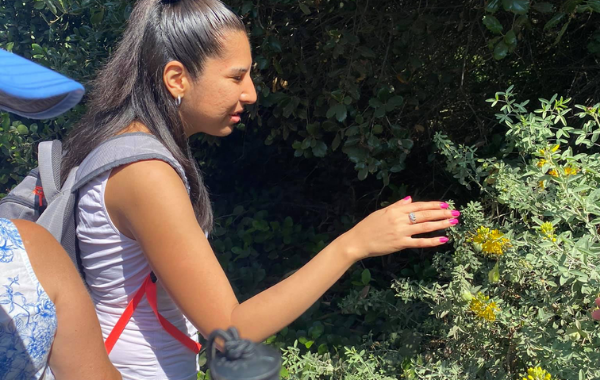
A Sighted Volunteer

Many participants from Hearts For Sight come to enjoy the hikes we sponsor. Together, Hearts For Sight and Sierra Club ICO/Central Group gather a mix of sighted and visually impaired people for monthly outings to our state and local parks.

We enjoy the gifts of nature: the birds chirping, the wind blowing and the water flowing by. Walking with my unsighted companion, I describe the flora and fauna that I see. VIPs use their sense of touch, smell and hearing to experience it for themselves.

Joseph tells me that many VIPs are not born blind and have a visual memory of the things that we describe to them. Sharing the nature trails with VIPs, I continue to be impressed by the strong sense of self and resilience of my unsighted companions.

Photo Credit: Ann Salvador

Equal Access To Nature

“VIPs are an afterthought of the community. We expect that they are to remain indoors and not have access to public goods, like parks and nature preserves. The Sierra Club gave us an opportunity to [discover the] accessible trails and natural habitats LA has to offer.”

These are the words of Joseph Burton who, along with Racquel Decipeda, founded Hearts For Sight: https://heartsforsightfoundation.org/.

He is so right—our parks and trails are for everyone to enjoy, and we are proud to help give access to these areas (with the assistance of a generous grant from Parks California).

A Route To Health

Being in outdoor spaces improves health and well being for all of us. To quote Joseph, “The feeling of isolation in our population is a real thing. What better way to engage with other people than to do it outside, and do it while you are exercising? That is eco-therapeutics.”

The Hearts For Sight/Sierra Club outings allow us to engage as a community and be healthy while enjoying the gifts of nature out on the trails.

Article by Firoza Jhabvala originally published in Parks California Newsletter
parkscalifornia.org/2021/08/13/a-perfect-marriage/

⋅ A SEASON OF WOES - FIRE AND ICE IN LA ⋅


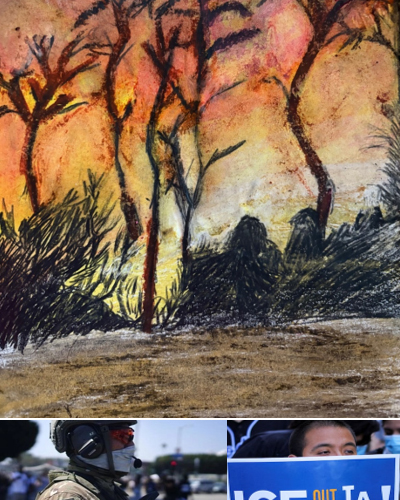
Los Angeles January 2025: A terrible windstorm fanned the flames of 2 fires as they raged out of control for days. Most of the neighborhoods in Pacific Palisades, Malibu and Altadena  burnt down. The evacuation system worked well, but not well enough for the 31 people that died.

Los Angeles June 2025: Our own federal government turned on us. They sent masked federal immigration agents (ICE) to kidnap innocent people from their communities. Some people were here without papers, others were nabbed even though they were here with permission till their cases were heard. Some were grabbed by mistake and then let go after languishing in detention. It is truly frightening to have a masked person snatch you off the streets and take you away to prison.

Our mayor, governor, immigration organizations and the people of LA have stood up and fought back against the attacks of the federal government.  In all, 5000 people were taken away as these attacks continue, with almost 70% of them having no record of any crime. How can this happen? Why is it that many think this is OK to happen to others as long as it is not happening to them? There are more questions than answers when it comes to how we treat each other.

We will rebuild

and

we will resist

AN EVERCHANGING EARTH: 

What would the bottom of the sea sound like without the inventions of modern man? That would be the sound of Los Angeles millions of years ago in the Miocene era. Moving and colliding tectonic plates, earthquakes and crashing waves would replace the sounds of construction and freeway traffic of our modern times. Much of coastal and even inland Los Angeles was under the sea in this ancient time as we learn from the fossils found in the hills and plains of Los Angeles. These ancient sea fossils predate the unfortunate ancient mammals from the Pleistocene era whose bones and fossils are found stuck in the tar of Los Angeles.

Like a giant lying dormant, Los Angeles only recently emerged from the ocean through a combination of tectonic shifts and climate change. The climate began to cool in the Pleistocene epoch and gigantic ice sheets formed over much of North America. These sheets trapped so much water that the sea level fell exposing land that had been at the bottom of the sea. As the climate warmed again and the sheets began to melt, the sea level rose to its current levels. This natural melting is now being accelerated by human caused climate change, which means that in 100 years parts of coastal Los Angeles could be a dormant giant under the sea again.

                                EARTH’S RECENT GEOLOGIC TIMESCALE


All over Los Angeles, we find these underwater fossils–in the mountains, on the plains and even in the desert. (map courtesy of Natural History Museum of Los Angeles)

What Are Underwater Fossils?

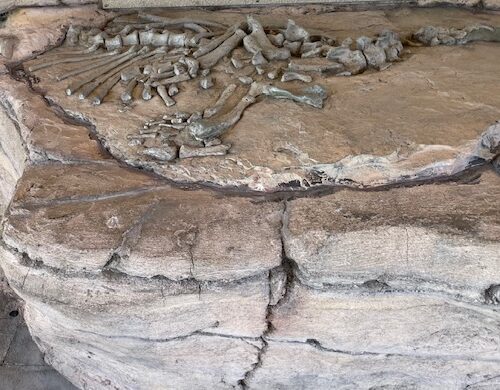
Underwater fossils are mineralized remains of sea and shore animals. When an animal died, its remains were buried under layers of mud and silt at the ocean floor. As the organic matter partially or completely dissolved, it would be replaced by minerals within its pores. When it completely dissolved, its mold would remain in the rock or fossilized algae (diatomite), giving us clues of life on Earth at an earlier time. Many of the fossils found in these Miocene era seas are from families still living in the Pacific Ocean today.


                   SAN PEDRO

San Pedro High School is in San Pedro, home to The Port of Los Angeles. There, digging for some construction, the workers found a vast bed of undersea fossils. There were some fossils in a shell bed from the later Pleistocene era, dating back about 120,000 years. Further digging found a bone bed filled with  8.7 million year old fish and marine mammals encased in diatomite rock (created from fossilized algae) and limestone (created from fossilized bones).


San Pedro High School


Mandible of sabretooth salmon found at SP High
Mastodon teeth found at SP High


San Pedro Cabrillo Marine Aquarium

CABRILLO MUSEUM EXHIBITS

Fish Fossil at Cabrillo
Ancient Pinniped Fossil


Whale Baleen
Whale jaw bone


More Mastodon Teeth
Whale Brain


A fossil I found near Cabrillo Beach (possible whale vertebrae)


 PALOS VERDES

Near San Pedro, on the same peninsula, created from the Monterey formation, is Palos Verdes. Whale bones and fish fossils are found here in the shale, diatomite and Malaga mudstone. The Point Vicente Interpretive Center has some of these 9 million year old treasures on display.


Fish fossil (top) and mastodon teeth (bottom)
Whale vertebrae and ribs


Topanga State Park

As we take our journey further north up the coast, we get to the Santa Monica Mountains. Topanga is home to many fossil shells found in the mountains.  The marine sandstone and siltstone are part of the Topanga Formation where invertebrate fossils such as  Turritella are found.

Turritella, a screw-shaped mollusk with whorls and spiral ribbing, found burrowed into seabeds


Malibu Creek State Park

  Malibu Creek is part of the Conejo Volcanic Formation which covers large portions of the Santa Monica Mountains. Erupting in the Miocene Epoch, this volcano spewed  lava. mud and ash to create this park’s volcanic rock gorges and crags from its molten rock. The fossils here are found in sedimentary rocks such as sandstone and shale.

Whale backbone fossil at the Malibu Creek Nature Center
Shells and Scallop Fossils at Malibu Creek Nature Center


A very rich source of information is the Natural History Museum of Los Angeles County near downtown LA. This Museum maintains a library of fossils found around Los Angeles. The following photos are from their exhibition called LA Underwater. The exhibition shows where the fossils were found, many miles away from the modern coast.


Lantern Fish Fossil found in Sherman Oaks in the San Fernando Valley
Pipefish fossil found in Sherman Oaks in the San Fernando Valley


Croaker Fish skeleton from Miocene Epoch found inland in Little Armenia, near Hollywood


Myocene era scallop fossils found near Rampart Village near Koreatown, Los Angeles
Demostylian jaw-Miocene epoch hippo-like marine creatures. Found near Studio City inland in the San Fernando Valley.